By Nikkita Mulchandani, Managing Director
A Turkish wedding in London usually runs as two or three events: a kına gecesi, or henna night, a day or two before; a civil nikah that makes the marriage legal; and the düğün, where the takı and the halay take place. How a family orders and combines them sets the venue, the running order, and the guest list.
At Meridian Grand we hosted 308 weddings last year, and Turkish families plan around a sequence of their own. Each event below appears in the order it happens, with the legal steps in England alongside.
What is the order of a Turkish wedding in London?
A traditional Turkish wedding moves through six stages: kız isteme, when the groom’s family asks for the bride’s hand; söz, the promise; nişan, the engagement; kına gecesi, the henna night; nikah, the marriage ceremony; and düğün, the wedding celebration. Kız isteme and söz usually take place at home. From the nişan onwards, families tend to book a venue.
- Kız isteme. The groom’s family visits the bride’s family to ask for her hand. Turkish coffee is served, and by custom the bride may add salt to the groom’s cup.
- Söz. A small family gathering that confirms the agreement between the two families.
- Nişan. The engagement. The couple’s rings are tied together with a red ribbon, and an elder of the family cuts it.
- Kına gecesi. The henna night, held for the bride a day or two before the wedding.
- Nikah. The marriage ceremony. In Turkish usage this usually means the civil ceremony, with an imam nikahı as an optional religious ceremony.
- Düğün. The wedding celebration, with the couple’s entrance, the takı, dinner, and the halay.
From the first visit to the düğün, the sequence traditionally unfolds over months. London families tend to compress the last three stages. The nikah and the düğün commonly fall on the same day, one leading into the other, and the kına gecesi moves to the evening or the weekend before, which keeps travel manageable for relatives coming from Türkiye.
What happens at a kına gecesi?
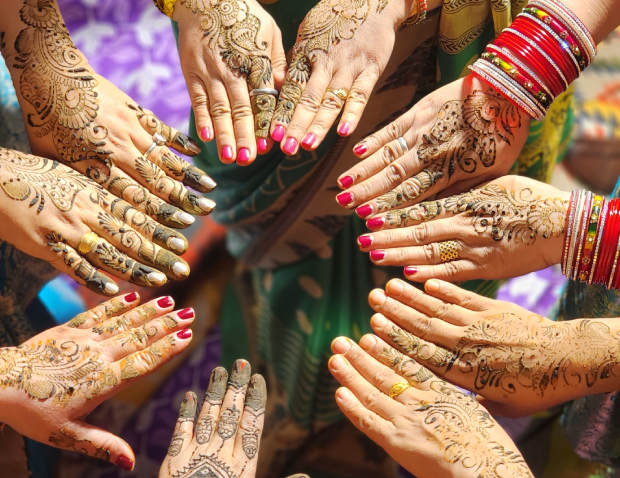
A kına gecesi is the bride’s henna night, held a day or two before the wedding. Family and friends gather, folk songs are sung, and henna is applied to the bride’s palm and to the groom’s little finger. Guests traditionally try to make the bride cry, marking her farewell to her family home before the celebration turns to laughter.
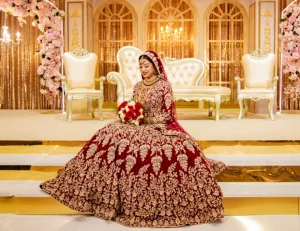
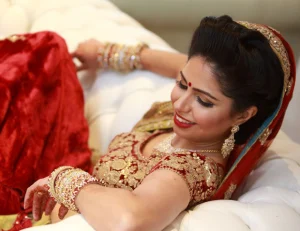
The bride usually wears a red or purple velvet dress, often a bindallı, with a red veil over her face. Unmarried friends circle her holding candles while songs such as “Yüksek Yüksek Tepelere” are sung. When the henna is applied, the bride keeps her hand closed until her mother-in-law places a gold coin in her palm, a custom GoTürkiye, Türkiye’s official tourism portal, lists among the most common henna-night rituals. Her hands are then wrapped in red cloth.
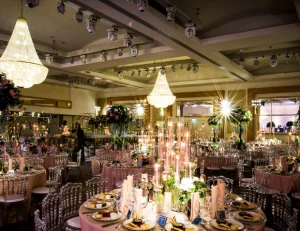
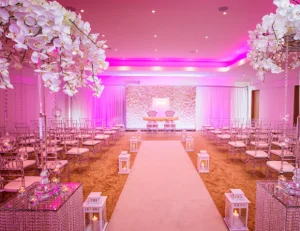
The kına gecesi is traditionally a women’s evening, and each family decides whether men join for part of it. It is also smaller than the düğün, typically 50–200 guests. The Eternity Suite takes up to 100 seated guests, which keeps a smaller night from feeling lost in a large room; a longer guest list moves to the Meridian Ballroom, which takes 400 seated guests. Décor by Midnight Garden can dress either room in red and gold. If you want the candle circle, agree it with your Event Coordinator when you plan the room, alongside the music and the henna table.
What does nikah mean at a Turkish wedding, and is it legal in England?
At a Turkish wedding, nikah usually means the civil ceremony. In Türkiye a marriage officer performs the legal marriage, and under Article 143 of the Turkish Civil Code a religious ceremony cannot take place until the couple show the family booklet, the aile cüzdanı, issued at that civil ceremony. In England, too, a registrar conducts the legal ceremony.
That differs from how Pakistani and Bengali Muslim families use the word, where nikah refers to the Islamic marriage contract. For Turkish couples a religious imam nikahı is optional, and on its own it is not a legal marriage in England and Wales. Our guide to nikah ceremonies covers the religious ceremony and the government’s 2026 consultation on weddings law.
The civil ceremony at the venue
A civil ceremony can take place at a register office or at an approved venue. Meridian Grand appears on the GOV.UK list of approved premises, and registrars from Enfield Register Office conduct ceremonies here. Both partners give notice at their local register office at least 29 days before the ceremony, and at least two witnesses must attend.
Two points shape the running order. Under GOV.UK guidance, a civil ceremony can include readings, songs, or music but nothing religious, so an imam nikahı, if you want one, runs as a separate ceremony. Registrar availability at approved venues is often the tighter constraint, particularly at weekends, so confirm the ceremony time with the register office before you fix the rest of the day.
Some customs carry over to a civil ceremony here, such as stepping on each other’s foot after the vows; GoTürkiye notes that whoever steps first is said to have the final say in the marriage.
Registering the marriage in Türkiye
Turkish citizens who marry in England register the marriage with the Turkish Consulate General in London, a process called evlilik tescili, so that it is recorded in Türkiye. The consulate accepts applications by post or by appointment, with the UK marriage certificate and Turkish identity cards.
Before the wedding, it also issues the evlenme ehliyet belgesi, a certificate of eligibility to marry, for citizens marrying before UK authorities. The document list differs when one partner is not a Turkish citizen, so check the consulate’s current requirements early.
What is the takı, and how long does it take?
The takı is the part of the düğün when guests pin gifts of gold and money on the couple. Close family go first, often with gold bracelets for the bride, followed by guests pinning gold coins or banknotes to red ribbons worn by the couple. It typically takes 30–60 minutes, depending on the number of guests.
GoTürkiye describes the gold as a practical gift, chosen so it can be exchanged for money and help the couple start their life together. The customary coin is the çeyrek altın, a quarter gold coin. Some families have a relative or the MC announce each gift as it is pinned; others prefer that nothing is read out. Decide which before the day so the MC knows.
The decision that matters most is where the takı sits. Before dinner, guests queue while the kitchen holds hot food. After dinner, it eats into the halay. Either works when the timings are fixed in advance. Leave space beside the couple for the photographer and a clear route for the queue, and seat the eldest relatives near the front so they are not standing for half an hour.
What is the halay, and how much space does it need?
The halay is a line dance performed with linked hands or little fingers, led by the halaybaşı, who waves a handkerchief, the mendil, at the head of the line. It is traditionally played on davul and zurna, drum and shawm, and the line can stretch the width of a ballroom, so it needs a clear, pillar-free dance floor.
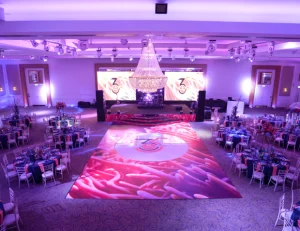
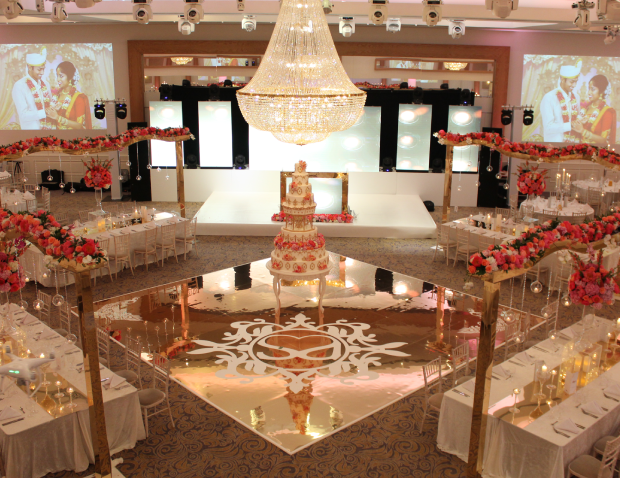
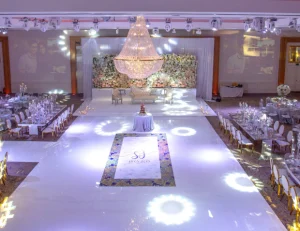
Pillars break the line, and a sound limiter cuts the volume just as the davul builds. The Grand Ballroom takes 700 seated guests on a pillar-free floor, live davul and zurna are welcome, and there is no sound limiter. Events finish by 3am at the latest, which leaves room for a long halay after dinner.
Families from the Black Sea coast may also want the horon, and Aegean families the zeybek. Tell the DJ or band which dances matter to your family so the evening builds towards them.
What food is served at a Turkish wedding in London?
A Turkish wedding menu at Meridian Grand runs to four courses: cold meze with warm Turkish bread, hot starters, a plated main on şehriyeli pilav, and pistachio baklava to close. The kitchen is halal as standard. The bar can serve rakı, wine, and beer, or stay closed for a dry wedding, and çay runs throughout the evening.
Cold meze reaches the table first: hummus, cacık, kısır, and sarma. Hot starters follow, with Arnavut ciğeri, sigara böreği, and hellim. Mains are chosen from lamb chops, lamb shank, köfte, and chicken or lamb patlıcan, with a vegetarian main on every menu. Families who want to taste before they commit can arrange a tasting with the kitchen.
How do you choose a North London venue for a Turkish wedding?
Look for one building that can hold the civil ceremony, the düğün, and, if needed, the kına gecesi, with an approved-premises licence, a pillar-free floor for the halay, time for the takı, live davul and zurna, and a halal kitchen with a bar. Location matters too, because much of London’s Turkish-speaking community lives in Enfield, Haringey, and Hackney.
Enfield is home to 18,765 residents whose main language is Turkish, more than any other local authority in England and Wales. With Haringey and Hackney, it accounts for about a third of the 112,978 people in England and Wales who gave Turkish as their main language in the 2021 Census, according to the Office for National Statistics. The figure counts main language only, so bilingual households who mainly speak English do not appear in it.
Meridian Grand sits in Edmonton, in the London Borough of Enfield, minutes from Green Lanes and Wood Green and just off the A406 North Circular. The Grand Ballroom takes 700 seated guests and the Meridian Ballroom 400, and together they form the Meridian Grand Ballroom for up to 800. Every booking has a dedicated Event Coordinator, and on-site parking keeps elderly relatives close to the door.
Questions worth asking any venue for a Turkish wedding:
- Is the venue on the GOV.UK list of approved premises, and which register office supplies the registrars?
- Can the civil ceremony room be reset for the düğün, or is there a second space?
- How much time does the running order allow for the takı?
- Is the dance floor free of pillars, and is there a sound limiter?
- Are live davul and zurna permitted, and what is the finish time?
- Is the kitchen halal as standard, and can the bar serve rakı or stay closed?
- Is there a smaller room for the kına gecesi?
Our Turkish weddings page sets out how each of these works here.
Frequently asked questions
How many days does a Turkish wedding last?
From kız isteme to the düğün, the full sequence traditionally unfolds over several months. The wedding events themselves commonly take two days in London: the kına gecesi on the evening or weekend before, then the civil nikah and the düğün on the same day. Families who hold a nişan add a third event, often months earlier.
Is a Turkish wedding legal in the UK?
In England and Wales, a Turkish wedding is legal once a civil ceremony takes place, conducted by a registrar at a register office or an approved venue, with at least two witnesses. An imam nikahı on its own is a religious ceremony and does not create a legal marriage. Both partners give notice at their local register office at least 29 days before.
Do we need to register our UK marriage in Türkiye?
Turkish citizens who marry in England register the marriage with the Turkish Consulate General in London so that it is recorded in Türkiye. The process is called evlilik tescili. Applications go by post or by appointment, with the UK marriage certificate and identity documents, and the document list differs when one partner is not a Turkish citizen.
Can the kına gecesi and the wedding be held at the same venue?
Yes. The kına gecesi usually takes place on a different evening and in a smaller room than the düğün. The Eternity Suite takes up to 100 seated guests for a kına night, and the Meridian Ballroom takes 400 seated guests when the list is longer. Holding both in one building keeps the suppliers, the décor, and the Event Coordinator the same.
Can we serve rakı at a Turkish wedding, or hold a dry wedding?
Either. The venue’s licensed bar can serve rakı with the meze, alongside wine and beer, for families who want it. For a dry wedding the bar does not serve, and the menu carries on unchanged, with çay and Turkish coffee throughout. The kitchen is halal as standard in both cases.
How do you arrange a viewing for a Turkish wedding?
If you are planning a Turkish wedding in London and want the civil ceremony, the takı, and the halay in one building, arrange a private viewing. We will walk you through the Grand Ballroom floor for the halay and the Eternity Suite for a kına gecesi, then draft a running order for your date.
Nikkita Mulchandani is Managing Director of Meridian Grand.