By Shiv Sanghani, Sales & Events Manager at Meridian Grand
Meridian Grand is the Nigerian wedding venue London families plan around for one-day celebrations at 200 to 600 seated guests. Most Nigerian weddings we host run as a single full day — engagement straight into reception in one pillar-free ballroom, with the Aso Ebi colour, the Alaga energy and the Owambe scale held together by one coordinator, one room and one timeline. Nigerian weddings at scale need one large room, food the elders are judging by the Jollof, and a venue that supports the spraying and the volume rather than policing them. The structure below comes from planning hundreds of Yoruba, Igbo and Hausa weddings here. A small minority of couples extend across two days — we cover that briefly — but the default and the strength is the one-day, one-room celebration. On this page:
- Why most Nigerian weddings at Meridian Grand run as one big day
- Yoruba, Igbo, Hausa — three traditions, not one “Nigerian wedding”
- 800 seated in one pillar-free room
- Aso Ebi, spraying, Owambe — what the venue supports
- Jollof, Suya, small chops, Pounded Yam
- Sound, lighting, late licence
- The couple stage, outfit changes and Midnight Garden
- Frequently asked questions
Why most Nigerian weddings at Meridian Grand run as one big day
Most Nigerian weddings at Meridian Grand run as a single full day. The Yoruba Igbeyawo, the Igbo Igba Nkwu or the Hausa Kamu opens in the morning or early afternoon. The room is reset across the lunch window. The white-wedding reception runs from late afternoon through to 1am — same building, same coordinator, same Aso Ebi colour palette carried across both halves. The logic is operational and cultural at the same time. One venue means the elders are not coordinating cars and timelines across the day. The bride and groom move once. The Alaga, the photographer, the videographer, the live band and the DJ all stay in one building. And the Aso Ebi colour reads as one composition from the first prostration through to the last dance, rather than as two visually disconnected events. A typical schedule looks like this: the traditional ceremony runs from late morning to early afternoon in the Grand Ballroom set for the Igbeyawo or Igba Nkwu. Guests break for a light lunch in the Meridian Ballroom while the main room is turned. The white-wedding reception opens around 5pm with the couple’s first entrance, the cake cutting, the speeches and the live-band build. Spraying and the Owambe dance floor land in the second half. The licence runs to 1am. A minority of couples extend across two days — usually when the Yoruba traditional engagement is hosted at the bride’s family home or a smaller venue the day before, with Meridian Grand carrying the reception alone the next day. Both patterns work; the two-day extension is the exception in our diary, not the rule, and most of this guide is written around the one-day flow.
Yoruba, Igbo, Hausa — three traditions, not one “Nigerian wedding”
Nigeria has over 250 ethnic groups, but most Nigerian weddings in London are Yoruba, Igbo or Hausa. They are not the same. The Yoruba Igbeyawo, the Igbo Igba Nkwu and the Hausa Fatiha differ in structure, dress, music, food and tone. A Nigerian wedding venue London worth shortlisting should be able to name which one you are planning before you have to explain it.
Yoruba weddings — Alaga, prostration, Aso Oke
Yoruba weddings are theatrical and structured. They are run by a professional Alaga — the female Alaga Ijoko for the bride’s family and the male Alaga Iduro for the groom’s. The Alagas control the pace and the protocol; they are not random family members. The ceremony moves through the formal letter from the groom’s family, the prostration (the groom and his male relatives lie fully flat before the bride’s family as a public sign of respect), the engagement list of symbolic gifts, the taste test of four flavours, the search for the bride, and the Aso Oke change — the bride receiving the hand-woven fabric gifted by the groom’s family. The reception then opens with the couple entering in Aso Oke to live Juju or Afrobeats.
Igbo weddings — Igba Nkwu and the kola nut
Igbo weddings centre on the Igba Nkwu Nwanyi, the wine-carrying ceremony. The bride is given a cup of palm wine by her father and walks into the seated guests searching for her groom. When she finds him she kneels and presents the wine. He drinks from it. The crowd erupts. It is the photograph of the day, and it needs to be captured from multiple angles. The kola nut ceremony — an elder breaking the nut and offering prayers — anchors the welcome. The men wear Isiagu (embroidered top with traditional hat); the women wear the elaborate George wrapper.
Hausa weddings — Fatiha, Kamu, fully Halal
Hausa weddings are Muslim ceremonies and share structural ground with Pakistani weddings — Nikah, Walima, segregation, no alcohol — with distinct Hausa elements. The Kamu is the formal family meeting. The Fatiha is the Islamic marriage ceremony equivalent to the Nikah. Kai Amarya is the ceremonial escorting of the bride to the groom’s home. Gender segregation is more common; the kitchen must be fully Halal across all service; the colour palette leans gold, green and white. The wedding runs without a bar.
800 seated in one pillar-free room — the capacity that decides the shortlist
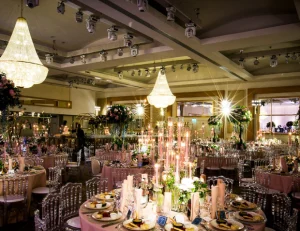
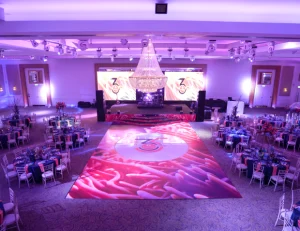
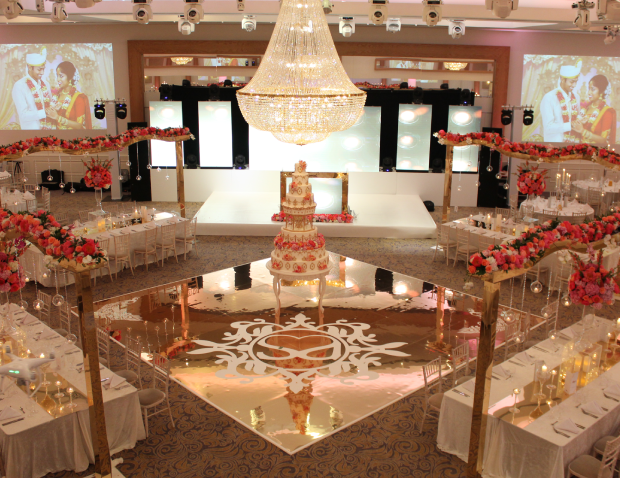
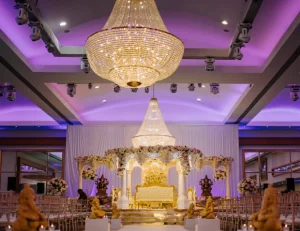
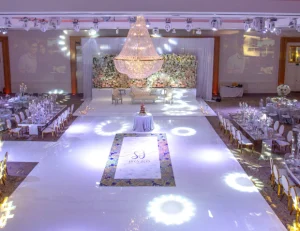
Nigerian receptions sit between 200 and 600 seated guests in London, with the larger end of our diary running closer to 800. The Grand Ballroom at Meridian Grand seats up to 800 in a single pillar-free room — no partitions, no overflow to a second hall. That single-room scale is what makes the Owambe land. Splitting 600 guests across two rooms breaks the energy and breaks the photograph. Partitions are the operational test most London venues fail for Nigerian weddings. A curtain or movable wall across the middle of one hall is not a single room — guests can see across, hear across, and the dance floor never fills the way it should. We do not partition the Grand Ballroom for Nigerian receptions unless the brief calls for a separate Hausa segregated layout, which is a different design altogether. Sightlines from every table to the couple stage matter for the Igba Nkwu moment, the spraying, the cake cutting and the first dance. The pillar-free build means every seat reads the room. At 200 guests the Meridian Ballroom holds the day on its own; at 350 and above the Grand Ballroom is the default; at 500 to 800 the Grand Ballroom carries the full Owambe in one piece.
Aso Ebi, spraying, Owambe — what the venue supports, not polices
Aso Ebi (the coordinated family fabric guests wear), spraying (notes placed on the dancing couple as a public expression of love) and Owambe (the full-volume Nigerian celebration culture) are not chaos to be managed. They are the wedding. Picking a Nigerian wedding venue London that supports rather than polices them is the brief. At Meridian Grand the décor is built around the Aso Ebi colour, the floor is set for spraying, and the sound policy and licence carry the Owambe through to 1am. Aso Ebi means “family cloth” in Yoruba. The couple chooses the fabric and the colour; family and friends buy matching cloth and wear it to the wedding. At 500 guests the visual effect is a single coordinated room — a sea of one colour in motion. Midnight Garden, our in-house décor studio, coordinates the floral, drapery and stage palette to the family’s Aso Ebi choice so the room reads as one composition rather than three colour schemes fighting each other. Spraying is the moment guests step onto the dance floor and place money on the couple as they dance. It is a beloved tradition across Yoruba and Igbo celebrations and a routine part of an Owambe reception. Our floor team is briefed to expect it, sweep discreetly between sets and handle the notes with care. We do not police it and we do not interrupt the dance. Owambe — the Yoruba word for a high-energy party — describes the cultural register of a Nigerian reception. Packed dance floor, full bar at Yoruba and Igbo Christian weddings, live band and DJ alternating sets, two to three outfit changes for the couple. The brief to the venue is to amplify it. No sound limiter. Late licence. Lighting designed for the dance floor, not the dinner.
Jollof, Suya, small chops, Pounded Yam — the food the family is judging
Nigerian wedding catering needs Jollof rice cooked properly, Suya grilled to order, small chops in genuine quantity, and Pounded Yam with Egusi or Pepper Soup served hot. Meridian Grand’s in-house kitchen handles the full Nigerian menu at 500-plus covers — Yoruba, Igbo and Hausa preferences distinguished — with fully Halal-only service for Hausa Muslim weddings and a full bar for Yoruba and Igbo Christian celebrations. Jollof is the centrepiece and every family has an opinion. We cook it on the day, in stock, the colour and depth that come from a proper tomato base and slow heat. Suya — spiced grilled meat skewers — runs as a live station if the brief asks for it. Small chops (the Nigerian term for canapés: puff puff, spring rolls, samosas, chicken skewers) are the first thing guests eat and the first thing they remember. Skimping on small chops is noticed within ten minutes of arrival. Pounded Yam with Egusi soup, fried rice alongside the Jollof, Pepper Soup, Asun (spicy grilled goat), Chin Chin on the table — the menu is built generously. Nigerian celebrations read abundance as good hosting, so the portion scale is set accordingly. The buffet is the standard service style; plated dinners do not carry the cultural register most families want. For Hausa Muslim weddings the kitchen runs fully Halal with no alcohol service, our Halal certification carried across to all West African dishes. For Yoruba and Igbo Christian weddings the full bar runs alongside catering — palm wine for the traditional ceremony if the brief calls for it, full drinks service for the reception. See our in-house catering in more detail.
No sound limiter, integrated lighting, late licence — building the reception as a production
A Nigerian reception is a production, not a dinner. Afrobeats, Juju, Highlife and live-band sets need volume the room can carry, lighting that shifts state with the energy, and a licence that runs to the natural close of the night. Meridian Grand has no sound limiter, integrated production lighting in both ballrooms, and a licence that runs to 1am as standard. Sound limiters — devices that cut the music when the room exceeds a set decibel level — are standard in London venues with residential neighbours and a non-starter for an Owambe reception. We do not have one. A 12-piece Juju band, a Wizkid or Burna Boy DJ set, a Davido drop at midnight — the rig and the licence carry them at the volume the family wants. Lighting is integrated production lighting rather than bolt-on hire: colour washes, dance-floor pattern lighting, spotlighting on the couple stage and the entrance, layered ambient lighting controlled live across the night. The state shifts deliberately — restrained for the traditional ceremony, opening through dinner and speeches, peaking into the Owambe dance floor, pulling back for the cake cutting and the closing dance. Late licence runs to 1am. Most Nigerian receptions at Meridian Grand close around that time with a deliberate wind-down through the final hour rather than a hard cut at midnight.
The couple stage, outfit changes and what Midnight Garden handles
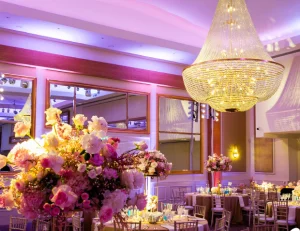
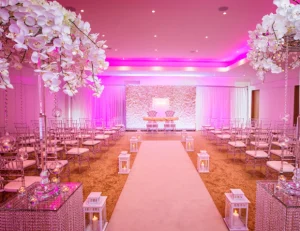
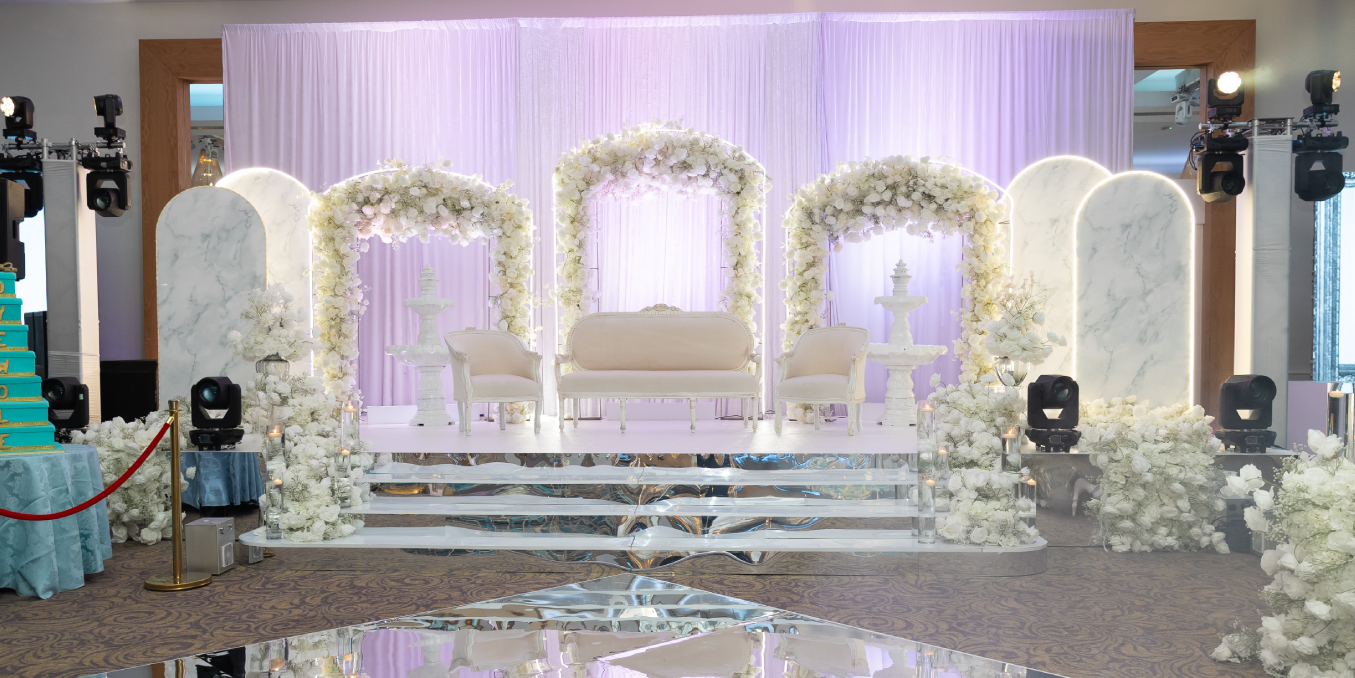
In any Nigerian wedding venue London worth shortlisting, the couple stage is the focal point of the reception — elevated, framed, photographed from every angle. Midnight Garden designs it as a piece of architecture rather than a backdrop. Bold colour, dramatic draping, statement floral, integrated lighting — built around the family’s Aso Ebi palette and the tribal aesthetic, not a generic wedding-stage template. Nigerian design palettes lean bolder than South Asian or Somali styling. Royal blue with gold, deep burgundy with cream, emerald with bronze — the colour discipline is what holds the photography together. Midnight Garden coordinates the stage, the tablescape, the entrance arch and the floral installations to one palette so the reception reads as one composition end to end. Outfit changes are standard — two to three across the reception. A Yoruba couple opens in Aso Oke for the Igbeyawo, switches to a Western look for the white-wedding entrance, and often closes in a third statement outfit for the Owambe dance floor. Private prep space sits adjacent to the Grand Ballroom so changes are quick and discreet. The photographer is briefed to expect the transitions and to use them. The stage carries the cake cutting, the first dance, the couple-photo windows, the spraying moments and the Igba Nkwu for Igbo weddings. Built right, it carries the family’s photographs for forty years.
Frequently asked questions
Can you host a Yoruba engagement and reception on the same day at one venue?
Yes. Most Yoruba weddings at Meridian Grand run the Igbeyawo (traditional engagement) in the morning or early afternoon, with the white-wedding reception in the evening — same building, same coordinator, room reset between the two halves. The day is designed to read as one cohesive celebration with two ceremonial registers, not two separate events sharing a postcode.
Is spraying allowed inside the venue?
Yes. Spraying is a beloved Nigerian tradition and a core moment of the Owambe reception. The floor team is briefed to expect it, sweep discreetly between sets and handle the notes with care. We do not police it, we do not interrupt the dance, and we do not write it into rules that conflict with the tradition.
Can you cater an authentic Nigerian menu — Jollof, Pounded Yam, small chops — at 500 covers?
Yes. The in-house kitchen handles Jollof rice cooked on the day, Suya, small chops in proper quantity, Pounded Yam with Egusi, Pepper Soup, fried rice, Asun and Chin Chin at 500-plus covers. For Hausa Muslim weddings the kitchen runs fully Halal with no alcohol service. For Yoruba and Igbo Christian weddings, a full bar runs alongside.
Can we have a live band and a DJ?
Yes. The production infrastructure supports both — a live Juju, Highlife or Afrobeats band for the traditional ceremony and the reception build, plus a DJ for the dance floor sets. No sound limiter, integrated production lighting across both ballrooms, and a licence running to 1am.
For a Hausa Muslim wedding, can you deliver full Halal and segregation?
Yes. The kitchen is fully Halal, all meat certified, no non-Halal product handled. The two-ballroom layout supports full segregation with separate entrances, cloakrooms and service staff. Female-only staffing is available across the women’s side from the agreed segregation point onwards.
Ready to plan a Nigerian wedding at Meridian Grand?
The fastest way to know whether the venue holds the Owambe scale is to walk through it. Take the virtual tour to see the pillar-free Grand Ballroom and the room-reset flow. The African weddings page covers the venue’s broader West and East African capability. For couples planning across Yoruba and Hausa traditions in extended families, the Pakistani weddings post and Somali weddings post cover the multi-day and segregation patterns in detail. When you are ready to check your date, speak to the events team — we come back within one working day. Meridian Grand is the Nigerian wedding venue London families and elders shortlist together for Yoruba, Igbo and Hausa celebrations at 200 to 600 seated guests. Written by Shiv Sanghani, Sales & Events Manager at Meridian Grand. Meridian Grand is a pillar-free wedding and events venue in North London, hosting 200+ Pakistani, Bangladeshi, Nigerian, Somali, Sikh and Jewish weddings a year.