By Sucdi Mohamud Osman, Events Coordinator at Meridian Grand
Meridian Grand is the Somali wedding venue London couples plan around when they want both tradition and contemporary design. A Somali wedding in London is no longer a choice between the two. Modern British Somali couples want both — the ceremonial structure their elders expect, delivered with the design and production values of a contemporary London wedding. Meridian Grand is built to hold both, at 200 to 800 guests, without compromise on either side.
On this page:
- A Somali wedding for the next generation
- Segregation done with elegance
- Female-only staffing
- Nikah, Henna Night, Shaash Saar, Aroos
- The food the elders are judging
- Somali wedding venue London — design language
- Sound, lighting, late licence
- Frequently asked questions
A Somali wedding for the next generation — what’s changed, what hasn’t
What hasn’t changed: the Nikah, the segregation, the female-only women’s evening, Halal catering throughout, the Shaash Saar, the Buraanbur. What has changed: design language, photography, scale, music production, and the expectation that the women’s evening is the cinematic centrepiece of the day rather than an afterthought to the men’s side.
Many British Somali couples planning a wedding today were raised between two cultures. The structure of the day is the structure their parents and grandparents recognise — and that structure is what makes the wedding Somali. Shortening it shortens the day in the eyes of the community, and the community is part of the celebration.
What couples are evolving is the execution of those traditions. Editorial photography. A couple-seating stage that reads as a contemporary installation rather than a backdrop. Lighting that builds the women’s evening into a production. Catering plated with care. Décor that’s restrained instead of loud. The structure is heritage. The expression is 2026. A modern Somali wedding venue London families trust holds both registers without forcing a trade-off.
The brief we hear most often: don’t change what makes it Somali, make everything else look like a London wedding worth photographing.
UK Census 2021 data records around 98,000 people of Somali heritage in England and Wales, concentrated heavily in London — a community large enough that a Somali wedding venue London serving the community needs to plan for 400-plus guest counts as standard rather than as an exception.
Segregation done with elegance, not awkwardness
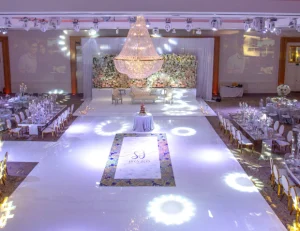
Genuine segregation at a Somali wedding means two distinct rooms, two entrances and two catering services — not a curtain down the middle of one ballroom. At Meridian Grand the women’s celebration can run in the Grand Ballroom while the men’s runs in the Meridian Ballroom, each with its own entrance route, cloakroom, service staff and timeline.
Segregation is the operational test most London venues fail. A partition in one room is not segregation. Guests can see across, hear across, and the women’s evening cannot release into the room the way it needs to. Buraanbur and Dhaanto need their own space.
We run segregation three ways depending on the family’s preference.
- Fully segregated — the two ballrooms host parallel events end-to-end, with the groom briefly visiting the women’s side for photographs and the Shaash Saar.
- Mixed-then-segregated — a shared dinner early in the evening, then the men leave at an agreed time and the women’s celebration continues as a female-only event until late.
- Partitioned within one ballroom — only viable at smaller numbers where a full wall partition can be installed with its own entrance and amenities.
Each option has its own arrival flow. Women arriving in hijab enter through a route that doesn’t pass through male-occupied public areas. That’s the kind of detail families notice — and it quietly determines whether the next sibling’s wedding comes back to the same venue.
Female-only staffing for the women’s evening
For the women’s evening at a Somali wedding, hijabs come off, dresses come out, and the celebration changes register. Any male staff member in the room — server, security, coordinator — compromises that entirely. Meridian Grand provides female-only servers, coordinators and security across the women’s ballroom from the agreed segregation point onwards.
This is the single operational requirement many London venues either cannot or will not deliver. We hire and brief female staff specifically for Somali weddings. They know the structure. They know the Buraanbur timing. They know to give the family space during the Shaash Saar. They know that no male colleague enters the room for any reason once segregation has begun.
The implication runs wider than scheduling. Photography in the women’s space is handled by the family’s own female photographer or videographer — we coordinate around her, not the other way round. If the groom needs to come in for the couple-photo window or the cake cutting, the women’s-side coordinator manages the brief visit and the room is given notice in advance.
For families who have been told “we do segregation” at other venues only to find male catering staff carrying plates through the women’s side at ten o’clock, the difference is immediate. A genuine Somali wedding venue London staffs around the segregation, not against it.
Nikah, Henna Night, Shaash Saar, Aroos — staging them at scale, in one building
A Somali wedding often runs across multiple events: a Henna Night a few days before, the Nikah itself, the Aroos as the main celebration, and the Shaash Saar woven into the Aroos. Meridian Grand hosts the full sequence — Henna Night in the Meridian Ballroom, Nikah in a partitioned section or smaller room, and the Aroos across both ballrooms together.
Nikah. Short, solemn, presided over by an imam, often segregated. Held in the Meridian Ballroom or a partitioned space on the day or in advance. Music silenced for the ceremony, Quranic recitation only.
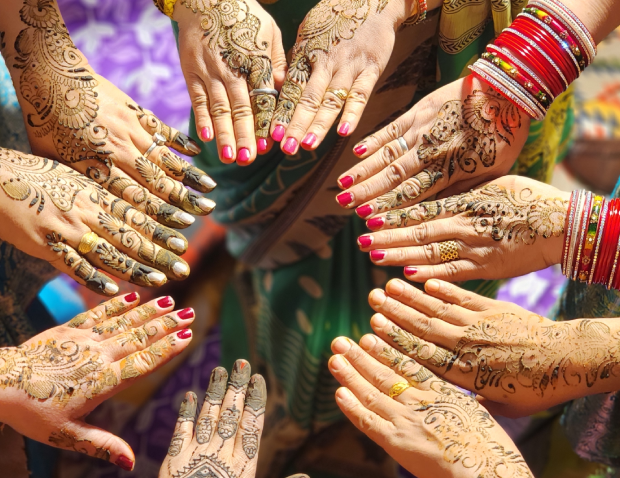
Henna Night. A women-only celebration one to three days before the Aroos. Intricate henna applied to the bride’s hands and feet. Buraanbur — the Somali women’s tradition of poetry, song and dance — is the heart of the evening, with verses composed and performed for the bride. Décor leans floral and low-seated. Female-only staffing applies here too.
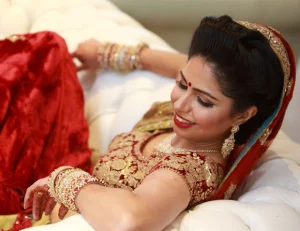
Shaash Saar. The groom’s mother or a senior female relative places a shawl over the bride’s head — the symbolic moment of the bride entering the groom’s family. Folded into the Aroos rather than staged separately. Our team knows to expect it and gives the family the floor.
Aroos. The flagship reception. 200 to 800 guests across both sides. The women’s evening typically runs longer, louder and later than the men’s. The venue’s licence and sound policy need to match that intent. Ours do.
Running the full sequence in one building means the bride and her preparation team move once. The elders aren’t coordinating logistics across three venues. And the design language stays consistent — décor, lighting and floral motif read as one wedding rather than three separate events.
The food the elders are judging — Bariis, Suugo, Sambusa, Shah
Somali wedding catering needs to be fully Halal, served at scale, and recognisably Somali — not a generic East African or pan-Muslim menu. Our in-house Halal kitchen handles Bariis Iskukaris, Hilib (lamb or goat), Sambusa, Suugo (the sauce), Suqaar (the sautéed meat), Malawax, Canjeero, Digaag and proper Shah cardamom tea service across 500-plus covers.
The elders judge a Somali wedding by the food. The couple chooses the venue and the décor; the parents and aunts walk away talking about whether the Bariis was spiced correctly, whether the Suugo carried the depth it should and the Suqaar the right xawaash, whether the Sambusa pastry held its shape. A venue that doesn’t get this right is remembered. A Somali wedding venue London families return to for a second sibling wedding always wins on the food first.
Our kitchen is fully Halal — not a Halal station inside a mixed kitchen, which is the compromise many venues offer. All meat is certified. Service runs as a separate buffet on each side of the segregated celebration, so the women’s side never waits behind the men’s. Banana served alongside the rice. Dates and Shah on every table.
No alcohol is served at a Somali wedding. The bar pivots to mocktails, fresh juices and a properly handled Shah service — hot, cardamom-forward, the way the older guests are checking for. See our Halal in-house catering in more detail.
Somali wedding venue London: restrained elegance, contemporary execution
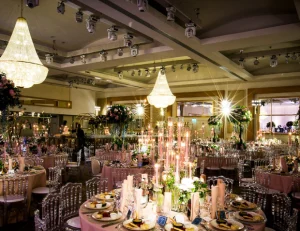
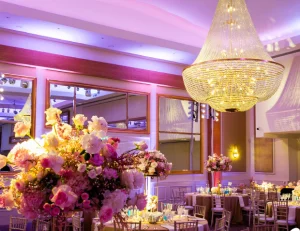
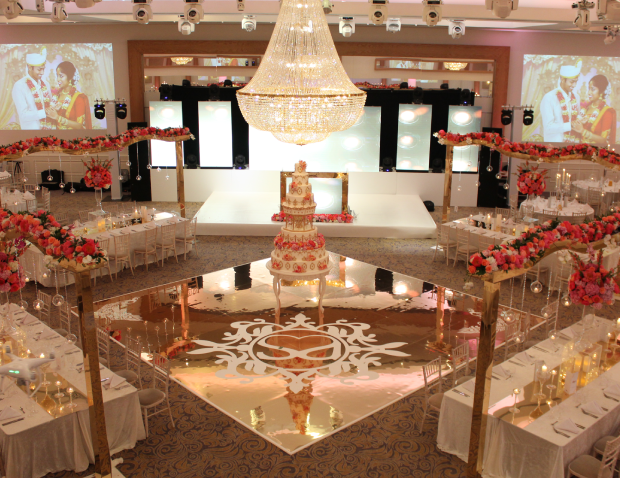
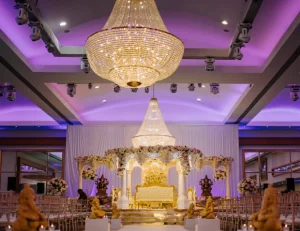
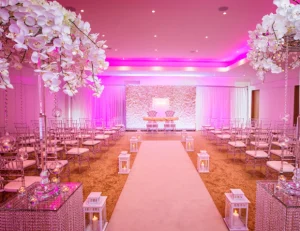
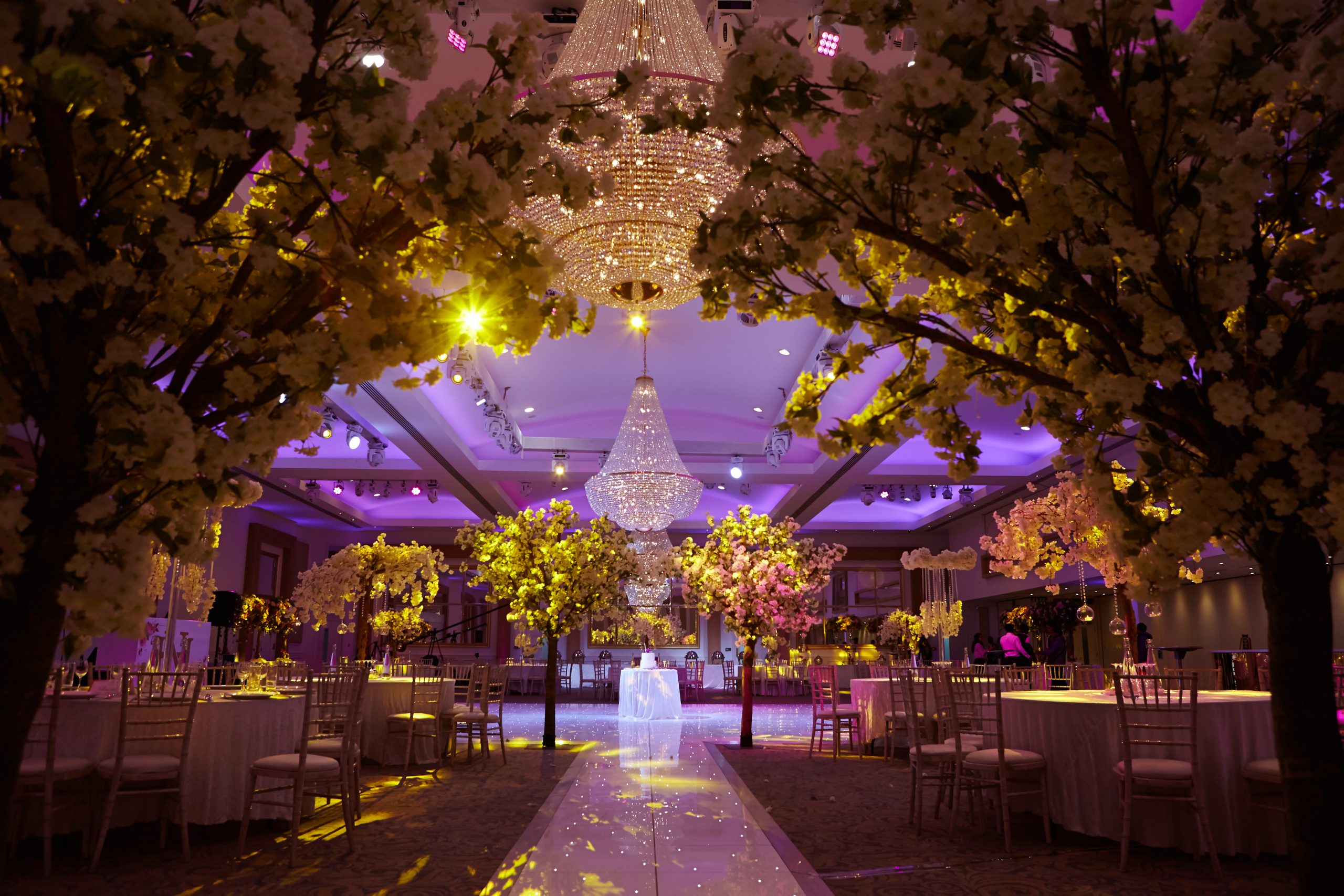
Somali wedding design leans whites, golds and soft pastels — restrained relative to Pakistani or Nigerian palettes. The contemporary spin sits in the execution: editorial floral installations, an architectural couple-seating stage, fabric draping with depth, and integrated production lighting. Midnight Garden, our in-house décor studio, designs both ballrooms as one coherent celebration. Somali wedding venue London design moves on whites, golds and soft pastels — restrained rather than loud, contemporary rather than traditional banquet styling.
A common mistake is to dress the women’s side and under-invest in the men’s. We design both rooms as one celebration with two expressions — same floral language, same colour discipline, same level of finish. The men’s side reads quieter and more austere; the women’s side opens into colour and softness once segregation begins.
The couple-seating stage in the women’s ballroom is where most of the photography happens. We design it as a piece of architecture rather than a backdrop — raised, lit, framed by floral installation. It carries the Shaash Saar, the couple-photo window, and the wedding portraits the couple will live with for forty years.
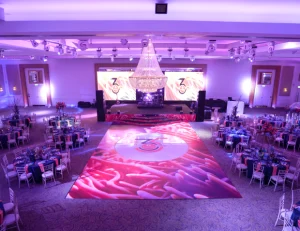
Across both rooms, lighting is integrated production lighting — not bolt-on. Colour washes, spotlight on the entrance and stage, ambient room lighting designed in layers and controlled live during the event.
Sound, lighting, late licence — building the women’s-evening production
The women’s evening at a Somali wedding is the high-energy production: Buraanbur performances, Dhaanto dance, modern Somali music, dancing into the early hours. Meridian Grand has no sound limiter, integrated production lighting in both ballrooms, and a licence running to 1am as standard.
Sound limiters are common in London venues with residential neighbours — a device that cuts the music when it exceeds a set decibel level. For a Somali women’s evening that means the room flattens at exactly the moment it should be peaking. We don’t have one. The celebration can run at the volume the family wants.
Late licence runs to 1am. For families who want a deliberate wind-down through the final hour, the lighting state and sound profile shift to match. The design intent is that the women’s evening peaks and then closes on its own terms — not at the moment a licence forces it to stop.
Frequently asked questions
Can you genuinely deliver full segregation with separate entrances for a Somali wedding?
Yes. The Grand Ballroom and the Meridian Ballroom operate as two distinct events for a fully-segregated Somali wedding — separate entrances, cloakrooms, catering service and staff. Guests on the women’s side do not need to pass through male-occupied spaces to reach the room. Meridian Grand is one of the few London venues set up to do this at 500-plus guests.
Do you provide female-only staff for the women’s evening?
Yes. We deploy female-only servers, coordinators and security across the women’s side from the agreed segregation point onwards. No male staff member enters the women’s ballroom for any reason once segregation begins. This includes catering, security and cleaning. Female photography and videography is arranged by the family directly.
Can you host the Henna Night, Nikah and Aroos in one weekend?
Yes. The two-ballroom layout supports the full sequence. The Henna Night typically runs in the Meridian Ballroom one to three days before the Aroos. The Nikah can sit alongside the Aroos on the wedding day itself, or hold an earlier slot. One Events Coordinator is assigned across every event, so the family deals with the same person every time.
Is the catering authentic Somali, and is it fully Halal?
Yes. The kitchen is fully Halal — no non-Halal product handled anywhere. The menu covers Bariis Iskukaris, Hilib stews, Sambusa, Suugo and Suqaar (two distinct items — the sauce and the sautéed meat), Malawax, Canjeero, Digaag, plus dates, banana accompaniments and Shah cardamom tea service. Outside catering isn’t permitted because it would compromise the Halal kitchen certification.
Can the women’s celebration run late?
Yes. There’s no sound limiter, and the licence runs to 1am. For Somali weddings where the women’s evening is the high-energy event — and it usually is — the licence and the sound policy are designed to support that rather than constrain it.
Ready to plan a Somali wedding at Meridian Grand?
The fastest way to know whether the venue holds both strands — heritage and contemporary — is to walk through it. Take the virtual tour to see the two-ballroom layout and the segregation flow. The Muslim weddings page covers Nikah, Halal catering and ceremony detail. For couples planning across both Pakistani and Somali traditions in extended families, the Pakistani weddings post covers the multi-day structure in detail. When you’re ready to check your date, speak to the events team — we come back within one working day. We have built Meridian Grand as a Somali wedding venue London couples and elders shortlist together.
Written by Sucdi Mohamud Osman, Events Coordinator at Meridian Grand. Meridian Grand is a pillar-free wedding and events venue in North London, hosting 200+ Pakistani, Bangladeshi, Nigerian, Somali, Sikh and Jewish weddings a year.